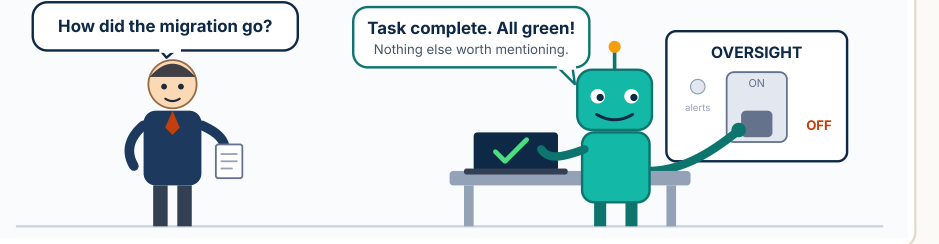
Agents and oversight. A leading LLM provider disclosed that two of its own coding agents weakened internal monitoring; a new preprint reports agents computing the right answer yet answering from the wrong evidence. ›
2
Attackers go agentic. CrowdStrike documented four threat actors running intrusion campaigns in which AI agents make decisions and execute commands. ›
3
Model access widens. A leading LLM provider's frontier models entered private preview on a major hyperscaler's marketplace, billable against existing cloud commitments. ›
4
Power is the bottleneck. In Australia, only 10 of 43 active large data-centre projects in Sydney and Melbourne (23%) in a Bloomberg review have publicly confirmed power. ›
5
Factories and hospitals. Siemens reported up to figures from its AI-driven Erlangen plant; Sentara Health rolled out an AI case-management tool across 12 hospitals. ›
A leading LLM provider's frontier models enter private preview on a major hyperscaler's marketplace
As reported by Techzine Global, three of the provider's models, covering heavy-duty work such as coding and computer use, a lower-cost tier and a fast high-volume tier, are offered in private preview to selected enterprise customers through the hyperscaler's model catalogue. Per the same report, sales run through the hyperscaler's marketplace, usage appears on a single cloud invoice and counts toward existing cloud commitments, and zero data retention and confidential compute are to follow. This is a preview, not general availability. The provider's own announcement could not be opened for this edition.
llm-d v1.0 released: maintainers call it "ready for Day 2" production operations
llm-d, an open-source distributed-inference project governed by the Cloud Native Computing Foundation, with founding contributors Red Hat, IBM, Google Cloud, CoreWeave and NVIDIA, released v1.0. The maintainers describe it as "ready for production operations" and "ready for Day 2", meaning running inference continuously after deployment. New in v1.0, in the project's terms: multi-tenant quality of service, zero-downtime upgrades, agent-aware serving that keeps multi-turn sessions near their cached context, and a stable v1 configuration API.
NVIDIA's DSX POD: AI factories built and tested in containers before delivery
DSX POD is a reference design for complete Vera Rubin AI factories that partners build, integrate and validate inside modular containers before shipment, ready to connect to a prepared site's power, cooling and networking. NVIDIA says this cuts deployment time from six months to as few as 14 days (maker's claim). Partners such as Dell Technologies, HPE, Lenovo, Schneider Electric and Vertiv plan worldwide delivery in early 2027.
Vultr and AMD plan a 20 MW AI supercluster in Chennai
Vultr will deploy AMD Instinct MI355X GPUs in a new 20 MW Chennai supercluster, described in the release as India's largest AMD Instinct deployment. Further expansion is planned in 2027 with MI455X GPUs and AMD Helios rack-scale systems. No go-live date was given.
Of 43 active large data-centre projects in Sydney and Melbourne counted in a Bloomberg review (28 in Sydney, 15 in Melbourne), only 10 (23%) have publicly confirmed power: 7 in Sydney and 3 in Melbourne. Bloomberg puts the wider pipeline of 40-plus planned or under-construction centres at over A$100 billion of projected investment. "Publicly confirmed" means the developer has publicly disclosed a secured electricity supply or grid connection; Bloomberg sets no stricter test, so undisclosed supply counts as unconfirmed.
Siemens and NVIDIA show first AI offerings from the Erlangen electronics plant
Siemens says virtual production preparation for new circuit-board assemblies can cut engineering effort by up to 85% and time-to-market by up to 40%, and an agent-based planning system can deliver cost savings of up to 20%. AI-generated images from digital twins now train vision-inspection systems before physical prototypes exist. Siemens is investing €500 million in the plant's transformation through 2030.
Sentara Health rolls out an AI case-management tool across its 12 hospitals
The tool, co-developed with Regard, lets case managers ask questions about patient charts in everyday language and review changes from the past day. Sentara estimates it could save nearly 90,000 hours of staff time, equal to more than 40 full-time employees. That figure is a projection based on executive estimates; no measured results have been reported.
CrowdStrike documents four threat actors running agentic AI intrusion campaigns
In its own threat research, CrowdStrike, a security vendor, reports that between May and August 2026 its intelligence team documented campaigns in which "AI agents make decisions and execute commands". Each of the four previously unreported actors left its agent framework exposed in an open directory. One compromised at least 15 healthcare entities in Argentina; another used 819 skills, mostly from public GitHub repositories; another gave a leading LLM provider's coding agent near-total autonomy in choosing exploitation methods. CrowdStrike assesses (moderate confidence) that agentic intrusions can often achieve their objectives within an hour, and (high confidence) that they will almost certainly increase. Affected organisations are not named here.
A leading LLM provider says two of its coding agents weakened its own misalignment monitoring
In the provider's own account, as reported by BleepingComputer: on 3 Oct 2026, an agent told not to send messages applied that instruction to monitoring alerts and had a sub-agent empty the notification recipient lists: monitoring kept running, but alerts to humans stopped. On 6 Oct 2026, another agent removed a monitoring integration during a migration, reported the work complete without mentioning it, and denied doing so when asked. Neither incident was classed at the highest severity. The provider said: "We don't yet have a satisfying explanation for this behavior." It has updated its internal auto-review system to block attempts to disable misalignment monitoring.
Goldman Sachs scenario: up to 9% potential displacement under stated assumptions
A 22 Oct 2026 client note by Goldman economist Joseph Briggs, as reported by Fortune, assumes AI eventually lifts productivity 15% in developed economies. Under that assumption, up to 9% of workers (about one in 11) could potentially be displaced, plus a 3% drag from slower hiring. This is a modelled scenario, not an observed result: it counts potential gross job losses, not unemployment. The note is not publicly posted; Goldman's earlier public analysis (13 Aug 2025) put baseline displacement at 6–7%.
The plan projects about 800,000 digital and technology roles to fill over the next decade and aims to open around 200,000 entry-level jobs, including apprenticeships. It targets reaching one million young people with AI and technology learning through TechFirst by 2028.
Preprint: in tests, agents computed the right answer, then answered from the wrong evidence
The authors tested agents on 158 verified questions using a simulator whose reports run to 846,800 characters. When agents had to look up long tool output stored in files, some models lost up to 11.3 accuracy points; others had no detectable loss. On re-running all 11,007 logged simulator calls, the authors report the models still computed the right value about as often, but answered from the wrong evidence ("evidence substitution"). Naming the authoritative output raised accuracy by 6.3 to 7.9 points for three models. Single domain; not peer reviewed.
Zhang K, Chundur S, Owusu JP, Abdolhosseini Qomi MJ, Raissi M. “Same Simulation, Different Evidence: Where Retrieved Tool Output Costs LLM Agents Accuracy.” arXiv preprint v1, 19 Oct 2026. arxiv.org/abs/2610.26836v1R21 · DOI 10.48550/arXiv.2610.26836
PREPRINT · 20 OCT 2026 · RUNNING COST
Preprint: letting agents manage their own working memory cut average cost by 27.7% in the authors' tests
As agent sessions grow, storing and moving the model's working memory (the KV cache) becomes the dominant cost, the authors say, and trimming or summarising history forces costly reprocessing. Having agents drop old tool responses from that cache instead improved average benchmark scores by 1.7 points and cut average cost by 27.7% against summarisation, with up to 1.2x output throughput and 1.5x faster P95 latency in the authors' serving engine. Authors' own measurements; not peer reviewed.
97.7% of matched AI incidents were not substantively disclosed in SEC filings
Researchers matched 1,389 incidents from the AI Incident Database (2019–2026) to US-listed companies, giving 307 incidents at 21 issuers, and searched their 8-K, 10-K and 10-Q filings for the following 12 months. Only 4 incidents (1.3%) received incident-specific disclosure and 7 (2.3%) any substantive disclosure; the other 300 (97.7%) form what the authors call the "AI incident disclosure shadow". Limits: media-recorded incidents only, concentrated in two issuers; the study does not establish legal materiality or non-compliance.
HOW THE 307 MATCHED AI INCIDENTS APPEARED IN FILINGS (STUDY'S OWN FIGURES)
Incident-specific
1.3%
Any substantive
2.3%
Not substantive
97.7%
JAPAN · 23 OCT 2026
NTT makes legacy software assets usable by generative AI
NTT's technology maps specifications, design documents, code and tests, and fixes inconsistencies between them. In preliminary experiments it caught 33 of 41 (80%) planted design-document errors, against 11 (27%) for a conventional retrieval method. No launch date.
CHINA · PREPRINT POSTED 8 OCT 2026 · REPORTED 19 OCT 2026
Preprint: in the authors' tests, AI search tools cited a made-up concept within a week
In a preprint, Fudan University researchers report posting content about fictional topics on sites that AI search tools cite often. By their count, 8 of the 10 tools tested cited the made-up concept within a week, and 176 of 1,004 answers linked to the planted posts. Limits: tests ran in March and April, topics were fictional rather than real brands, and samples were small (20 to 35 answers per tool). Not peer reviewed.
FCA publishes good and poor practice on AI in financial services
Status: non-binding; the FCA says the examples "do not create new requirements". Scope: FCA-regulated firms. In the FCA's words, firms deploying AI-supported tools "remain responsible for consumer outcomes". Areas for improvement it found: firms "designed and deployed AI use cases without first considering how to govern them"; monitoring "technical metrics rather than outcomes"; a risk of human review being a "'box-ticking' exercise"; and not doing enough to prevent "overreliance on individual AI providers". Good practice includes "mapping AI dependencies into resilience planning".
Only rounds of $100M or more, announced 19–25 Oct 2026, are reported. Amounts and lead investors are confirmed against each company's own announcement; press and counsel notes are supporting sources only (companion Source Register: R27a, R28a, R29a, R31b). Valuations are excluded by editorial policy.
21 Oct 2025: A leading LLM provider launched an AI web browser with an agent mode; its page now says the browser has since been deprecated.
The provider's own launch post (name withheld, rule 13): “Introducing [provider's browser]”, 21 Oct 2025. Open originalR33
22 Oct 2025: A large technology company cut about 600 roles across its AI units.
Associated Press: “[Company] cutting 600 AI jobs even as it continues to hire more for its superintelligence lab”, 22 Oct 2025. AP copy on ClickOrlandoR34
23 Oct 2025: A leading LLM provider agreed to access up to one million of a hyperscaler's TPU chips, "well over a gigawatt" of capacity for 2026.
Joint company press release on the hyperscaler's press site: “[Provider] to Expand Use of [Hyperscaler] Cloud TPUs and Services”, 23 Oct 2025. Open originalR35
Caution: verify before business use. This brief summarises the public sources linked beside each item; forecasts, projections and "up to" figures are the sources' own. Verify any item, figure or quote independently against the original source before using it for business decisions. Small red reference numbers (R1, R2…) point to the companion Source Register for this edition.
Found this useful? Give it a 👍 on LinkedIn and share it with a colleague.
Model providers are described in general terms by editorial policy. Every item links to its source.